Turn your idea into software your organization controls.
Describe what you need in a conversation. Arrakio turns the work into a Git-backed project that can be previewed, reviewed, changed, and deployed — with a clear path for developers to take part.
expense-reporting · example namespace
exampleconversation
workspace · managed, Git-backed
main · a1b2c3d — 4 files, 2 open
merge request · main ← report-workspace
merge passdeployment · target: production
Start with the problem, not the tooling.
Arrakio gives non-developers a conversational place to explain what they need, provide context, and refine the result. When the work becomes software, it continues as a managed project instead of an isolated chat response.
01
Describe the work
Begin in an AI-assisted conversation and add the context needed for the task.
02
Work with a real preview
Continue in a managed workspace with source and a hosted preview of finalized static output.
03
Bring in developers without starting over
Review and merge the same Git-backed work through an explicit project workflow.
One path from conversation to maintained software.
01
Conversation
Explain the need, add context, and refine the task.
02
Workspace
Arrakio carries the work in a managed, Git-backed workspace.
03
Review
Test the merge, inspect conflicts, and approve the change.
04
Deploy
Build an immutable deployment from a selected source and serve it through a configured target.
A few kinds of work people describe in a conversation.
These are example projects built with Arrakio. Each one is a real, hosted static site you can open — no accounts, no backend, and nothing to set up.
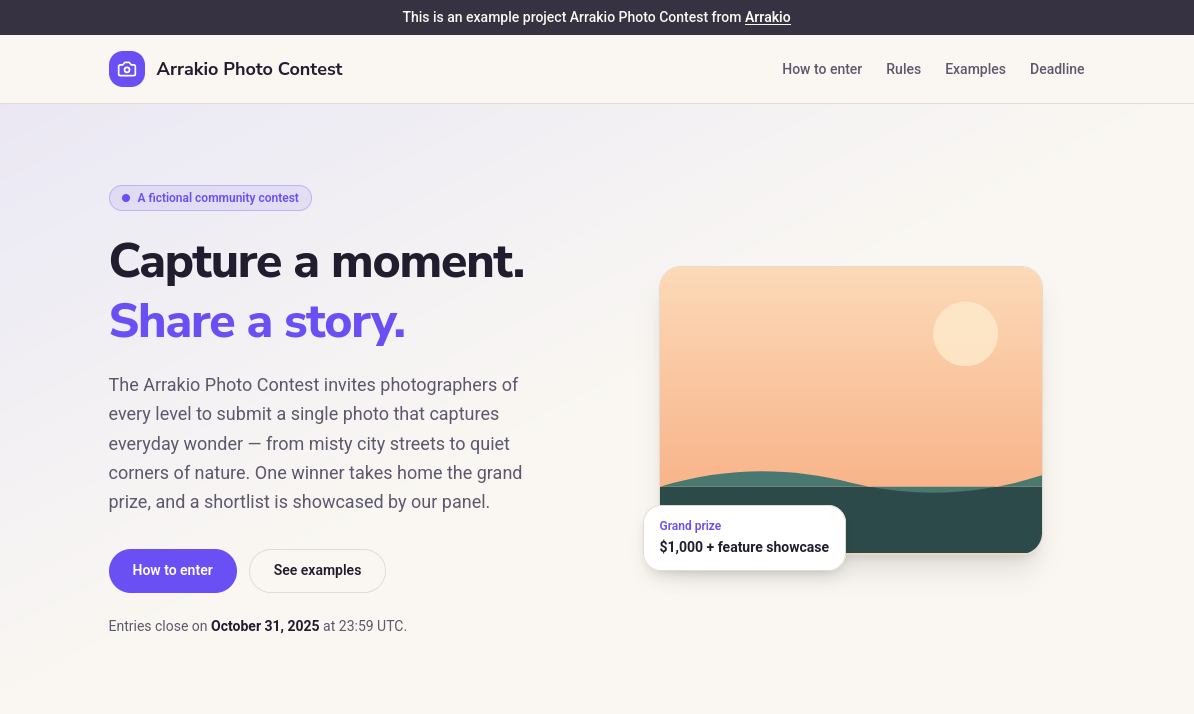
Photo contest page
A campaign page that explains the contest rules, shows example entries, and routes submissions to the team's existing email or form.
 Open output
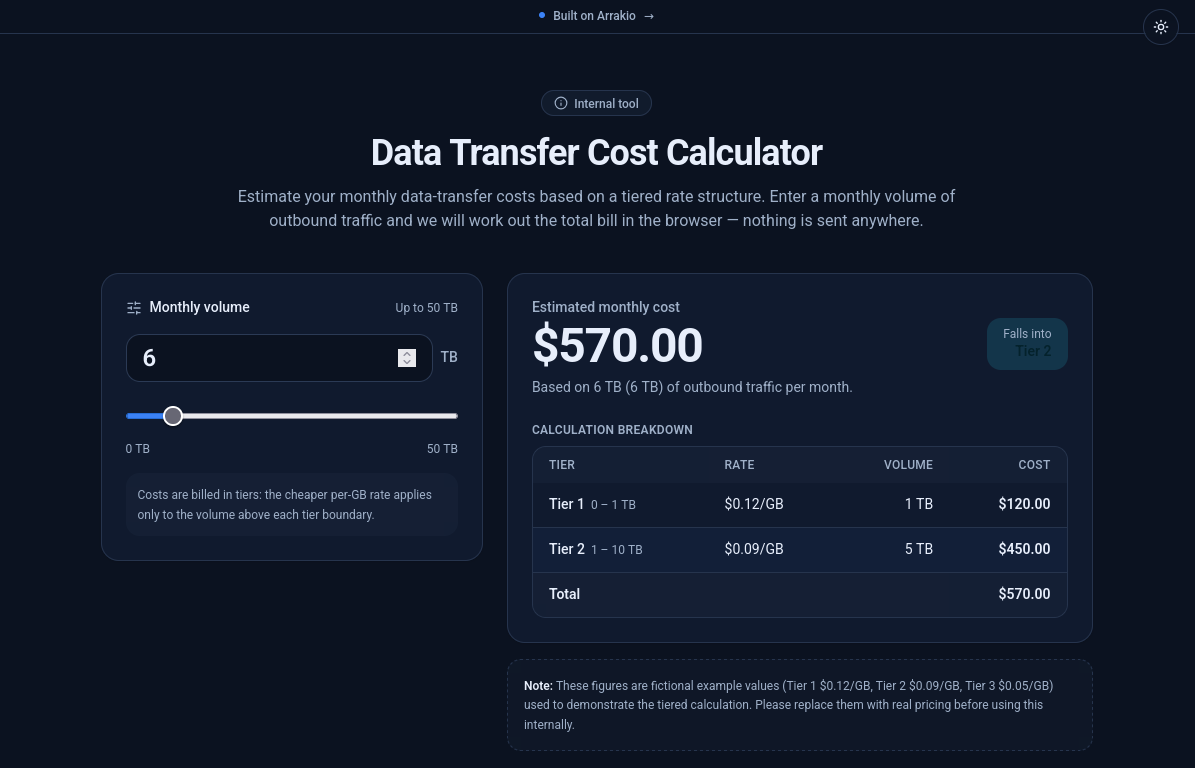
Data-transfer cost calculator
A tiered calculator teams use to estimate monthly data-transfer costs before planning volumes.
 Open output
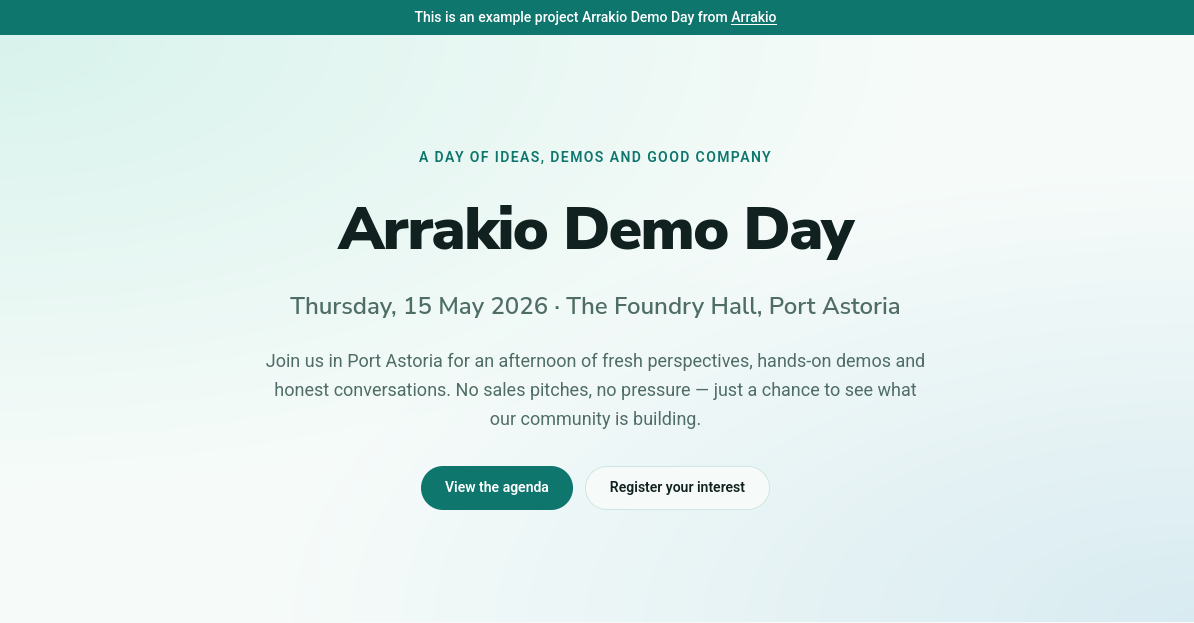
Event page
An event page with an agenda, sessions, and venue details — a structured page teams can keep updated.
 Open output
Interactive quiz
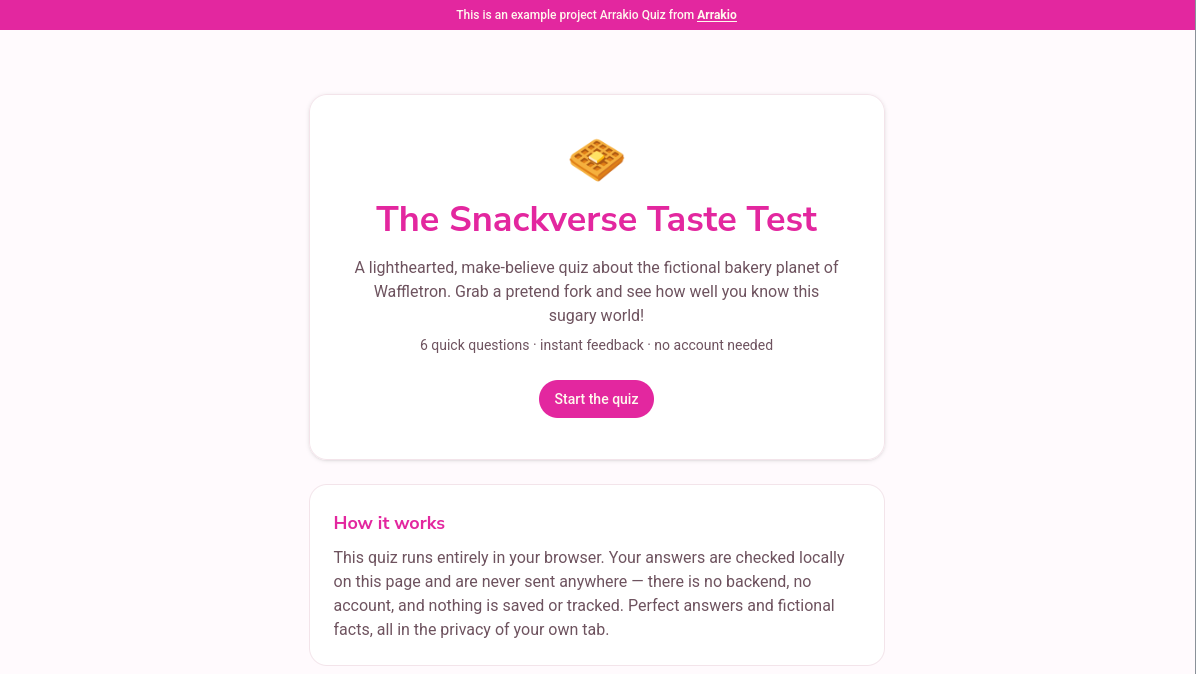
A multiple-choice quiz that runs entirely in the browser, with scoring and no backend or saved data.
 Open output
Choose where Arrakio runs and which services it uses.
Self-host Arrakio on infrastructure you control. Keep projects in Arrakio-managed Git repositories, configure storage for application data and artifacts, and connect external or private model endpoints according to your requirements.
your infrastructure
Arrakio backend
API + auth
Worker
background jobs
Runner-managed workspaces
isolated build + preview runs
PostgreSQL
application data
Configured storage
object / local
Arrakio-managed Git repositories
source + history
Static site service
hosted previews + deployments
optional configured boundaries
External model provider
configured
Private model endpoint
configured
operators choose whether external model or storage providers are configured
expense-reporting · merge request
examplesource workspace
workspaces/expense-reports
latest commit after feature
target workspace
expense-management
latest commit on branch
merge test
passconflicts
src/lib/reports.ts · src/pages/index.tsx
Developers get a project, not a dead end.
Arrakio keeps generated work in managed Git repositories and uses workspaces and merge requests to move changes forward. Developers can test a merge, inspect conflicts, continue the conversation, and approve the result without rebuilding the project from scratch.
- Work is held in managed Git repositories.
- Parallel work happens in workspaces.
- Merge requests create an explicit review boundary.
- Developers can test, review, resolve conflicts, and continue the work.
- Templates and component packages let teams provide reusable foundations.
- Self-hosted operators choose infrastructure and model providers.
Give every new project a foundation your team already understands.
When a project starts from a template, Arrakio backs the new work with a structure your team already knows — chosen stacks, conventions, and defaults — so the first generated result fits your organization instead of starting from a blank workspace.
Beyond templates, Arrakio supports component-library projects. A team can publish reusable components as versioned packages to Arrakio's internal npm-compatible registry and consume them from other Arrakio projects. Because publishing and versioning happen inside the same Git-backed workflow as the rest of the work, the foundation doesn't live in a separate system.
Template-backed project creation
A project conversation can begin from a template, sourced from your template catalog, so new work inherits an established structure.
Component-library projects
Reusable pieces live in dedicated library projects that other Arrakio workspaces depend on.
Versioned component packages
Components are published as versioned packages; teams pin and upgrade dependencies the way they would in any npm-based project.
Internal npm-compatible registry
Arrakio ships a registry so internal packages are installable across projects without a separate package host.
Teams keep control of what new work is built on — without asking every project to reinvent the same foundations.
Move from preview to a managed release.
- Deployment targets define where a project is released.
- Arrakio records deployments against exact source commits.
- Static site artifacts are served with managed or custom domains.
expense-reporting · deployments
exampletarget: production
livedeployment matches a selected source commit
target: staging
previewstatic artifact served
Try Arrakio with a cloud account and trial credits.
Request a trial account for the cloud-hosted version of Arrakio. The account includes a trial credit balance for using the product.